Rancho Cordova, CA · Garage Door Service
Is Your Rancho Cordova Garage Door Worth Fixing or Replacing?
Rancho Cordova homes mostly date 1962-2004. Here's how to tell if your original door and hardware are worth repairing or if it's time to replace.
- Repairs & new doors
- Springs & openers
- Serving 5 nearby communities
The Problem
Most houses in Rancho Cordova went up between 1962 and 2004, with the median build year landing around 1982. That means a lot of doors on the street are the original unit, or a replacement from the 80s or 90s that's now reaching the end of its own run. The call we get isn't usually "my door is broken," it's "is this worth fixing."
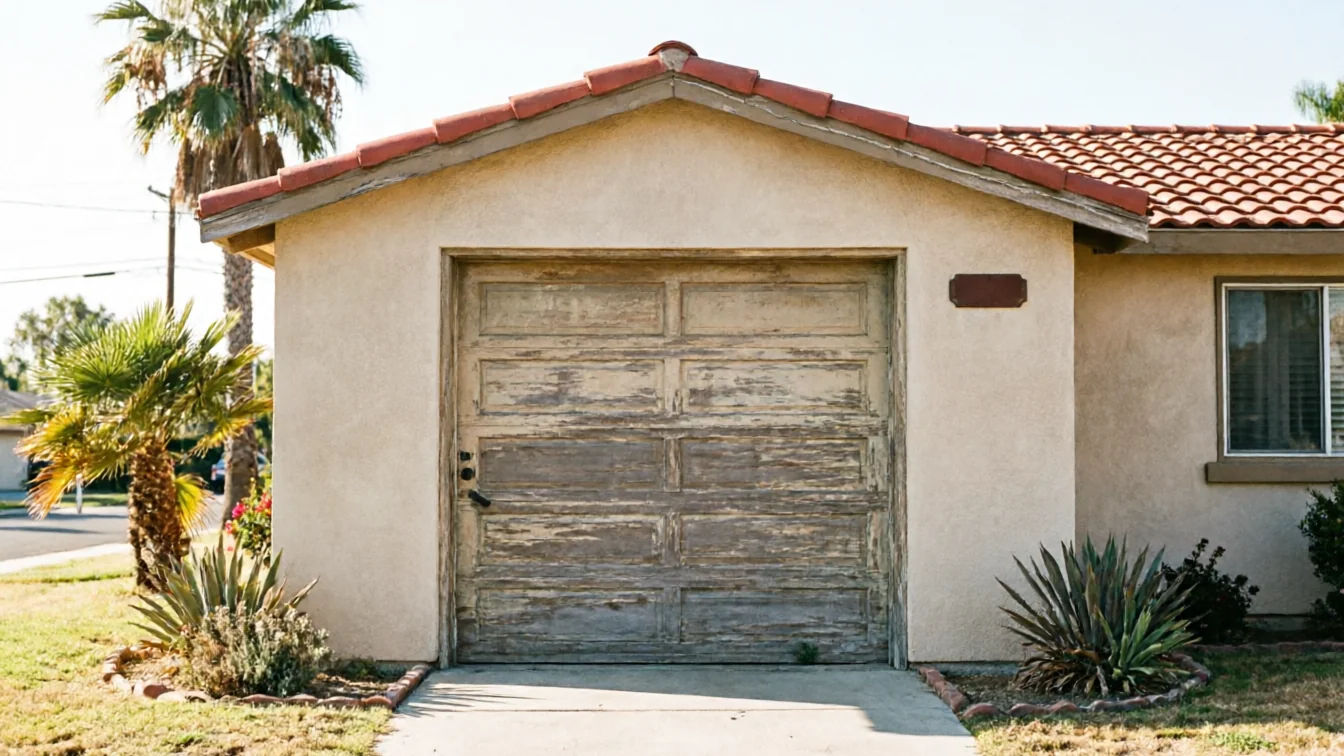
The honest answer depends on what's actually failing. A spring, a cable, a set of rollers, or an opener motor are all cheap to swap out on almost any door, old or new, and if that's the only problem, fixing it is the right call every time. The door panel itself is a different story. If the steel is rusted through at the bottom section, if the track is bent from years of a car bumping it, or if the door is one of the older one-piece styles instead of sectional panels, you're often chasing parts that newer doors don't use anymore. Across the 26 named areas that make up most of this stock - split pretty evenly between 1980s builds and 90s builds - we see the same split: hardware failures are worth fixing, structural failures on a 30-to-40-year-old door usually aren't.
What Changes With the Season
A door installed when the house was built in, say, 1985 has gone through roughly 40 years of temperature swings by now, and that matters more here than in a lot of places because of how hot this climate band runs. Steel panels expand and contract, and over decades that cycle works bolts loose, flattens weatherstripping, and dries out the lubricant in hinges and rollers faster than a newer door with better seals and finish would experience.
With 87,879 owner-occupied houses across the service area, we see this most in homes built during that 1962-2004 stretch where the door has never been touched since the original install. If your opener is straining more in summer than it used to, or the door feels heavier to lift by hand on a hot afternoon, that's usually the steel and the hardware telling you their age, not a one-time glitch.
What the Weather Here Does to It
The severe heat this area sees is hard on garage doors in ways that aren't obvious from the outside. Insulation foam inside older sectional panels breaks down under repeated heat cycling, and on uninsulated single-layer steel doors - common in houses from the earlier end of that 1962-2004 build range - the metal itself can warp slightly over enough summers, especially on south or west-facing garages that take direct sun most of the day.
That warping is one of the clearer signs a door isn't worth saving. A slightly bent track or a sagging spring is a repair. A warped panel that no longer sits flush in the frame, letting heat and dust into the garage, usually means the section needs replacing even if the rest of the door is sound. We'll tell you straight if that's what we're looking at rather than patching something that'll be back in a year.
What You Pay
We don't publish a flat price here because what you pay depends entirely on what's wrong - a roller job and a full panel replacement aren't in the same category, and we're not going to quote one number that fits both. What we can tell you is how we decide which way to go: if the fix is hardware (springs, cables, rollers, the opener), we almost always recommend fixing it, since that hardware is standardized and available regardless of how old the door itself is.
If the problem is the door panel, track, or frame on a door that's decades old, we'll walk you through the real comparison - cost of parts and labor to repair versus the cost of a new door - and let you decide. One limitation worth saying plainly: on some of the older one-piece doors common in this area's earliest housing stock, matching panels or hardware can take longer to source than it would for a standard sectional door, and that lead time is a real factor in whether fixing makes sense.
Frequently asked questions
My garage door is from the 80s, is it too old to repair?
Not necessarily. Age alone doesn't rule out a repair. If the problem is a spring, cable, roller, or opener, those parts are standardized and we can usually fix an 80s-era door the same as a new one. It's panel damage, rust-through, or a warped track on a decades-old door where replacement starts making more sense than repair.
Why does my door feel harder to open in summer?
Heat cycling over many years works bolts loose, dries out hinge lubricant, and can slightly warp uninsulated steel panels, especially on doors that face direct sun most of the day. If your door is from the 1962-2004 era and original to the house, the summer heat here is a real factor in how it's aging.
Is it ever not worth fixing a garage door?
Yes. If the panel is warped or rusted through, or the door is an older one-piece style where replacement parts are slow to source, repair costs can stack up to where a new door makes more sense. We'll tell you directly if we think that's the case for your door rather than patch something that'll fail again soon.
Related garage door services in Rancho Cordova
More garage door guides
Book garage door service in Rancho Cordova
Call now or request a quote - tell us what the door is doing and where you are.