Rancho Cordova, CA · Garage Door Service
Roller Replacement for Fair Oaks' 1977-Era Garage Doors
Fair Oaks homes built around 1977 are hitting the age where original steel rollers bind, chip, and jump track. We handle roller swaps from our Rancho Cordova shop, 5 miles out.
- Repairs & new doors
- Springs & openers
- Serving 5 nearby communities
How We Fix It
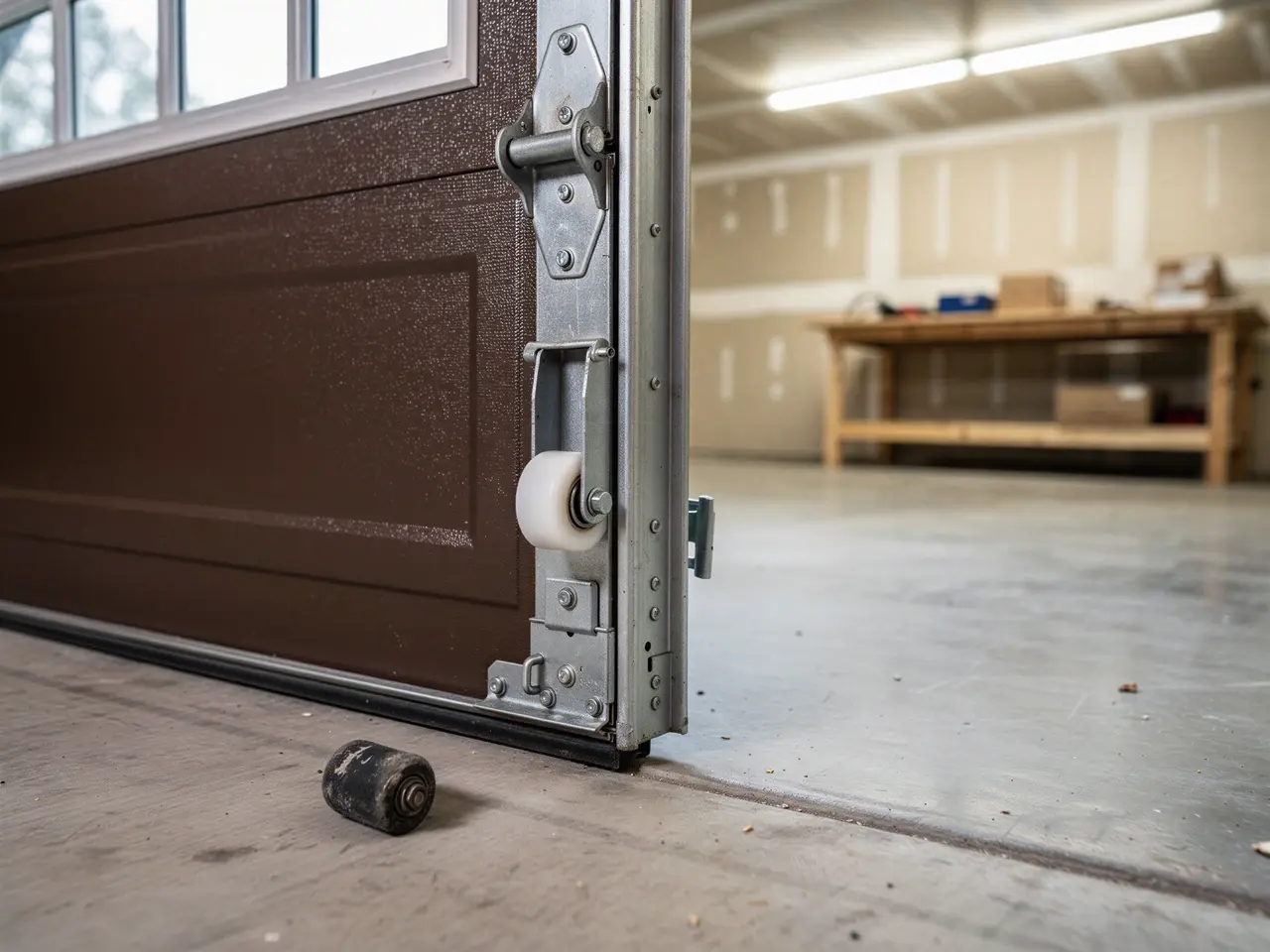
Most houses on this stretch of Fair Oaks went up around 1977, which puts the original steel rollers and their steel shafts at roughly 45-plus years old. Nobody replaces a roller on its own schedule - it gets replaced when it finally seizes in the bracket or shears off mid-cycle. We pull the door off its travel limit, support it on the track, and walk each roller stem out of the hinge rather than yanking the whole bracket, which is what tears the hinge plate on doors this age. On a steel roller stem that's rusted into the hinge, penetrating oil and time beat force every time - we don't want to replace a hinge plate that was never the problem.
We check the track alignment as we go. On a door this old, the rollers usually wore unevenly long before anyone noticed, and a worn roller chews the track lip over the years. If the track's bent from a roller that's been binding for a decade, we straighten or swap that section too, because a new roller in a bad track just wears out again in a season.
The job is quiet work, not a demolition. Springs stay put, the opener stays put, and the door comes down the same evening it went up - assuming nothing else on the hardware gives out mid-job, which does happen on original hardware.
Parts We Carry
For a 1977-era door we're usually looking at 2-inch steel rollers on a 7-foot track, sometimes 10-ball nylon rollers if a prior owner already upgraded once. We carry both. Steel rollers are what's likely original - they're louder, they transmit cold or heat straight into the track, and in this area's heat they expand and contract more than nylon does over a summer, which is part of why steel rollers on an old track start binding before nylon ones would.
We stock sealed-bearing nylon rollers in the common stem lengths for residential doors. These are the standard swap-in on a 1977 door: quieter, no lubrication needed, and they don't transfer vibration the way steel does. We don't stock every stem length or every specialty bracket on the truck - if your door uses an odd stem length or a custom bracket from a past repair, that part gets ordered and the job becomes two trips instead of one. We'll tell you up front if that's the case rather than mid-repair.
Doing It Yourself
Swapping a single roller on a double-door garage is within reach for someone comfortable with a ladder and a vise grip - unhook the roller from the lowest point of its travel, pull the stem out of the hinge, push the new one in. Where people get hurt is the top rollers near the spring and the torsion bar, or any roller on a door that's already sagging on one side. Don't release cable tension or touch a torsion spring to get a roller out; if a roller's stuck because the door's off-track, that's a different job than a roller swap.
If you're doing it yourself: replace rollers in sets of the same type, not one steel and one nylon on the same track, because they wear the track differently and the door starts to rock. And if the stem is bent instead of just worn, straightening it on your own doesn't buy you anything - a bent stem under load just bends again.
How It Shows Up
On a door built around 1977 with original steel rollers, the first sign is usually noise - a grinding or clicking that gets louder as the door nears the top of its travel, where the roller's spent the most cycles. After that, people notice the door catching or jumping slightly at one spot on the track every time, which is a flat spot worn into one roller. Left long enough, a roller can shear its stem clean off, and the door drops unevenly on that side until it's off the track entirely.
Fair Oaks sees real summer heat, and steel hardware that's baked and cooled every day for over four decades tends to seize at the stem before it visibly wears at the wheel. If your door's been quiet for years and suddenly starts barking every time it opens, that's usually the roller, not the opener.
What You Pay
We don't have a flat number to quote here, since it depends on how many rollers are bad, whether it's steel or nylon, and whether the track needs straightening along the way. What we can say: Fair Oaks households run a higher median income than the wider service area we cover out of Rancho Cordova, and we see more owners here choose the nylon upgrade over a like-for-like steel swap, since the quieter ride holds more appeal once the original hardware's already failing anyway.
We travel the 5 miles from our Rancho Cordova shop for this work; there's no separate local crew or depot in Fair Oaks, so the visit is scheduled the same way any Rancho Cordova call is. For the full rundown of roller pricing and how it's built, see our Rancho Cordova roller replacement page. For other garage door work in town, our Fair Oaks page covers the rest of what we do here.
Frequently asked questions
Are my rollers original if my house was built in the late 1970s?
Likely, if no one's mentioned replacing them. Steel rollers from a 1977-era build can run 40-plus years before failing outright, though they usually start grinding or sticking well before that. If you've never had a roller job done, what's on the track now is probably what went up with the door.
Should I switch to nylon rollers when mine fail?
Most people here do once the original steel rollers start going, since nylon runs quieter and doesn't need the periodic lubrication steel does. It's not required - steel is cheaper and holds up fine - but we see Fair Oaks owners choose the nylon upgrade more often than not.
Do you have a shop in Fair Oaks?
No. We run out of Rancho Cordova, about 5 miles away, and we come to you for the job. There's no separate Fair Oaks branch or faster local response - it's the same crew and same travel time as any call in that area.
Can a bad roller damage my track?
Yes, and on an older door it usually already has. A roller that's worn unevenly chews a flat spot into the track lip over years of use. If the track's bent or grooved, we'll flag it during the roller swap rather than put a new roller into a track that'll wear it out again.
Book garage door service in Rancho Cordova
Call now or request a quote - tell us what the door is doing and where you are.